About Sir Peter
From Liverpool, with purpose.
Born into a tough corner of post-war Merseyside, with a father who lost his sight and his job, the boy who'd wanted to be a fighter pilot found his way into computing instead. Fifty years later, the business he built employs around 9,000 people.
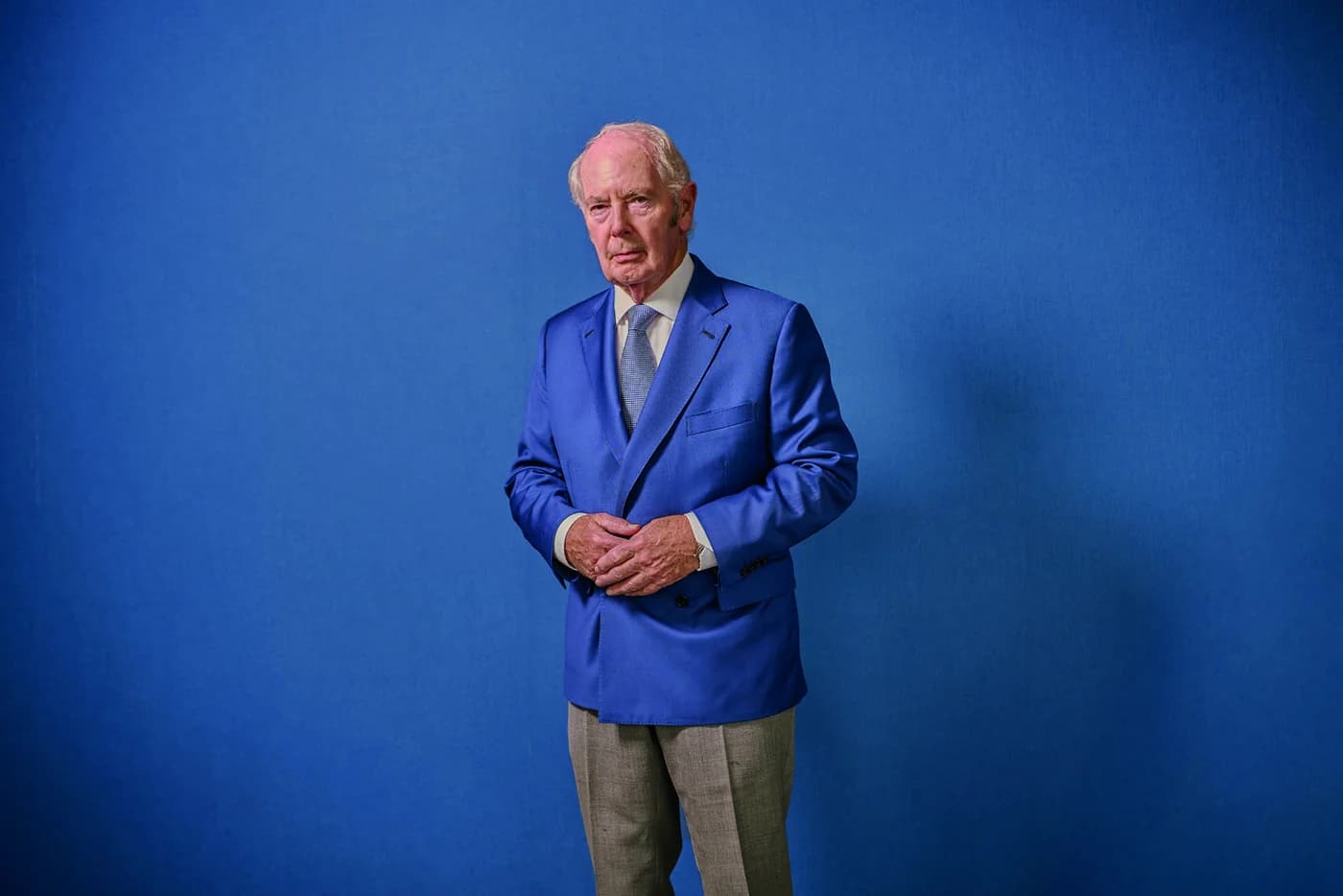
The Liverpool boy who wanted to fly
Sir Peter Rigby was born in Liverpool - “a tough old place,” as he puts it - and grew up determined to make something of himself. From the age of ten he had one ambition: to be a fighter pilot. He joined the Air Training Corps, learned to fly at fifteen, and won a scholarship to RAF Cranwell.
He never took it. His father had lost his job and his eyesight, and the two-pounds-fifty a week a cadet earned was not going to keep his family. At seventeen he went to work instead - and through a friend of his mother walked, almost by accident, into the British branch of an American computer company called NCR. They didn't know what to do with a seventeen-year-old with five O-levels, but they put him through the same programming courses as their computer-science graduates.
“My goal at seventeen was that I would never find myself in the same situation my father had found himself in.”
From sales territory to the world stage
He moved from NCR to Honeywell, where he was given a sales territory and quickly became one of the company's top salespeople in Europe. A brief, dazzled stint with the New York consulting firm John Diebold sent him to Frankfurt at twenty-two, presenting large-scale database management to audiences across Switzerland and Germany - until he decided, sensibly, that he was not yet qualified to be standing in front of those rooms. He went back to sales, became a branch manager, and watched the American conglomerate change its top management every three years. There was, he concluded, no career for him in it.
£2,000 and a recruitment business
He saved two thousand pounds - not enough to start a serious business, but enough to start one that needed little capital and could generate cash. In 1975 he founded SCR, a technology-recruitment firm in Birmingham, with two young children at home. The cash it threw off paid for the next step: a computer bureau using Honeywell technology. Then the IBM PC arrived, and his bureau became its first UK distributor. The business followed the technology - into local-area networks, into client-server, into data centres, into the cloud (his was the first private, sovereign cloud built for UK government, more than a decade before the rest of the country worried about where its data lived). It followed it geographically too: France, Belgium, the Netherlands, Poland, South Africa, Spain, Romania, Vietnam.
“Rigby Group has never been run solely for profit. Giving back has always been part of what we do.”
How the business has been run
He watched competitors operate on a different logic. The American conglomerates he started his career inside changed their top management every three years - each new arrival blaming the predecessor, then looking for a way back to the States. The big public companies he has competed against ever since slice off ten per cent of their workforce when results disappoint, because the payroll is the easiest line to take a knife to and the shareholders need a story. The Rigby Group has not been run that way. It has never been public. It has never sought outside equity. It has never put a business into administration. When difficult periods come, the conviction is to conserve people through them, not to discard them as a first move.
“I don't think you have to be ruthless to succeed in business.”
His mantra for management is unembarrassed and consistent: you lead from the front, like playing rugby, and you keep going forward. It is meant literally. When a Spanish warehouse burned to the ground he was on a plane to Madrid the next day; he told the team it was an opportunity for a better warehouse, and they got on with it. When the DANA floods devastated Valencia in 2024, the group's team was first on the scene restoring the regional government's data centre and helping the families who had been displaced. Crises do not become a reason to retreat from a place. They become a reason to belong to it more visibly.
And then there is the small ritual he has kept up for fifty years. Long-service medals - around a thousand of them across the group worldwide - presented in person, by him, with a handshake. When the team in Lousson outside Paris staged a ceremony a few months after a damaging union strike had nearly derailed the group's delivery to the Paris Olympics, he asked the staff for the list of names but specifically not to be told which of those names belonged to the five union representatives who had caused the trouble. He shook every hand the same. They have not forgotten it.
“The most important thing has been the people.”
Aviation, hotels - and the path back
The boyhood dream of flight resurfaced later, in less linear form. He became a helicopter pilot, then a fixed-wing pilot; he bought airports. For a time the group owned four of them, ran another dozen on contract including for the MOD in the Falklands, and developed a chain of ten country-house hotels alongside the technology business. The aviation interests have since been sold, the hotel portfolio quietly streamlined to the Eden Hotel Collection; the company today is focused on technology services, technology investments and real estate. But aviation came back another way: in 2017 the RAF reformed 601 Squadron of the Royal Auxiliary Air Force to advise its senior leadership, and Sir Peter was appointed one of its six officers. He is on his fourth tour. In 2025 he stood as wingman to the Chief of the Air Staff at the national commemoration of the Battle of Britain. The Liverpool boy who'd wanted to fly had come back through another door.
“It has been a kind of privilege to have gone full circle - from a cadet at fifteen to counting the present Chief of the Air Staff amongst my friends.”
The Foundation, and what followed
The Rigby Foundation was established in 1992 - a formal vehicle for what the family had been doing more informally for years. Over more than three decades it has supported hundreds of organisations, broad in spread, from Birmingham Children's Hospital to the Royal Shakespeare Company, from FareShare to the local-community minibus at Banners Gate. Three years ago the Foundation was refocused entirely on education, and Sir Peter set up the Sir Peter Rigby Charitable Trust for the things he wanted to keep going himself - heritage, the arts, naval aviation, and the small causes that don't fit neatly under any heading.
He was knighted in 2002 for services to information technology and to business in the Midlands; appointed to the Légion d'honneur in 2021 for his contribution to Franco-British business and cultural ties. He holds honorary degrees from Birmingham City, Aston, Liverpool, Birmingham and Cranfield. He continues as Chairman of the Rigby Group, alongside his two sons.
In his own words
“I have always believed that success in business should go hand-in-hand with giving back to society. That is why I established the Rigby Foundation in 1992.”
Sir Peter Rigby